
What Is Nafs in Islam: The Inner Self in the Quran and Sunnah
A deep, reflective exploration of the nafs, its three Quranic states, and the House of Nafs Ammara that keeps most of us trapped without even knowing it
Introduction: The Word That Explains Everything About You
Dear brothers and sisters, before we begin, I want you to understand something. Almost every problem in your life traces back to one word. One reality that most people never learn to identify. One dimension of the self that Islam has been trying to teach us about for fourteen hundred years, and yet most of us have never sat down and studied it properly.
That word is nafs.
The problems you cannot understand about yourself, the patterns you keep repeating despite knowing they hurt you, the sudden waves of anger and desire that feel like they come from nowhere, the difficulty you have staying consistent in prayer, in ibadah, in commitments you made to yourself with complete sincerity just weeks ago. All of this is happening because there is a dimension of you that you have not yet learned to see clearly.
The nafs is not your soul in the way English translations sometimes suggest. The nafs is not your heart in the way we usually think of it. The nafs is something else. Something with its own agenda. Something that has been part of you since you were born, that will remain with you until the moment you die, and that you must learn to educate, discipline, and eventually elevate if you want to live the life Allah ﷻ has actually called you to.
In this blog, we are going to sit down together and understand what the nafs actually is. We are going to look at what the Quran says about it. We are going to distinguish it from the ruh / soul (روح) and the qalb (heart), because most Muslims confuse these three. We are going to walk through the three Quranic states of the nafs, starting from the one most people are stuck at, moving toward the one Allah ﷻ actually calls us to become. And we are going to look at what I call the House of Nafs Ammara, because until you understand who lives in that house, you will keep losing the battle without realising who is fighting you.
Take your time with this. This is not a fast blog. This is a slow, deep sitting with a reality that is going to change how you see yourself.
Let us begin.
What Is Nafs: The Linguistic and Quranic Meaning
The word nafs (نفس) in Arabic linguistically comes from the same root as the word for "breath" and "self." Imam Al-Raghib al-Isfahani رحمه الله, in his classical work Al-Mufradat fi Gharib al-Quran,(المفردات في غريب القرآن ) discusses the multiple meanings the word carries. It can refer to the essence of a thing, itself, its inner reality. When Allah ﷻ uses the word in the Quran, it carries a specific meaning that classical scholars have unpacked with tremendous care.
In its most common Quranic usage, nafs refers to the inner dimension of the human being that experiences desire, is capable of good and evil, feels emotions, holds intentions, and either draws you toward Allah ﷻ or drags you away from Him depending on its state.
Allah ﷻ tells us in the Quran:

This verse alone tells us something extraordinary. The nafs was created by Allah ﷻ with two capacities inside it. Both the capacity for fujur فُجُور (wickedness) and the capacity for taqwa (God-consciousness). Not one or the other. Both. Every human being carries this dual inheritance inside them, and life becomes the arena in which the two capacities are tested against each other.
This is why understanding your nafs is not optional. This is why turning away from this study is a form of blindness. You cannot navigate a war if you cannot see the battlefield. Your nafs is the battlefield of your entire life.
The Difference Between Nafs, Ruh, and Qalb
In Islamic teaching, the nafs is one of three dimensions of the inner human being that scholars have identified through careful study of the Quran and Sunnah. These three dimensions are frequently confused, and understanding the distinction between them is essential.
One: The Ruh (الروح).
The ruh is the spirit. It is the divine breath that Allah ﷻ blew into Adam عليه السلام. It is what makes you alive in the highest sense. When Allah ﷻ was asked about the ruh, He said in the Quran:
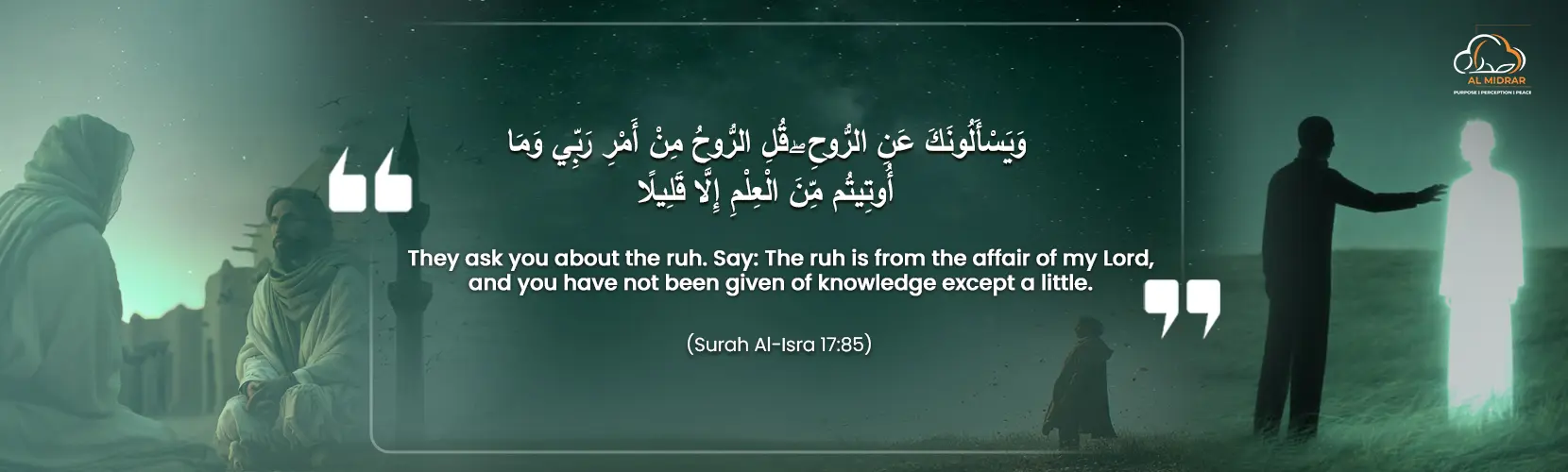
The ruh (روح) is a mystery. We know it exists, we know it comes from Allah ﷻ, but its full nature is beyond human understanding.
Two: The Qalb (القلب).
The qalb is the heart, and in Islamic understanding, it is not just the physical organ. It is the seat of iman, the place where guidance either takes root or is rejected, the centre of your moral perception. The Prophet ﷺ said, in a hadith recorded in Sahih al-Bukhari:
The qalb is where iman lives or dies. It is where the disease of the nafs shows its effects.
Three: The Nafs (النفس).
The nafs, distinct from both the ruh and the qalb, is the dimension of you that carries desires, appetites, ego, and the capacity for both good and evil. It is what pulls you toward comfort, toward pleasure, toward self-preservation. When it is disciplined and educated, it becomes an asset. When it is left to its own devices, it becomes the source of most of your suffering.
A simple way to see the difference: The ruh is what gives you life. The qalb is where your iman lives. The nafs is what wants things.
Beautiful people, understanding this distinction changes everything. Because now, when you feel a strong pull toward something you know is wrong, you can identify what is pulling you. It is not your heart. It is not your soul. It is your nafs. And once you can name it, you can begin to work with it.
The Three Types of Nafs in the Quran
Now we come to the heart of this discussion. The Quran describes the nafs in three distinct states. These are not three different nafs. It is the same nafs at three different stages of its development. Every human being has one nafs, but that nafs can be in a state of decay, a state of struggle, or a state of peace.
Ibn Al-Qayyim al-Jawziyya رحمه الله wrote in his classical work Madarij as-Salikin (مدارج السالكين ):
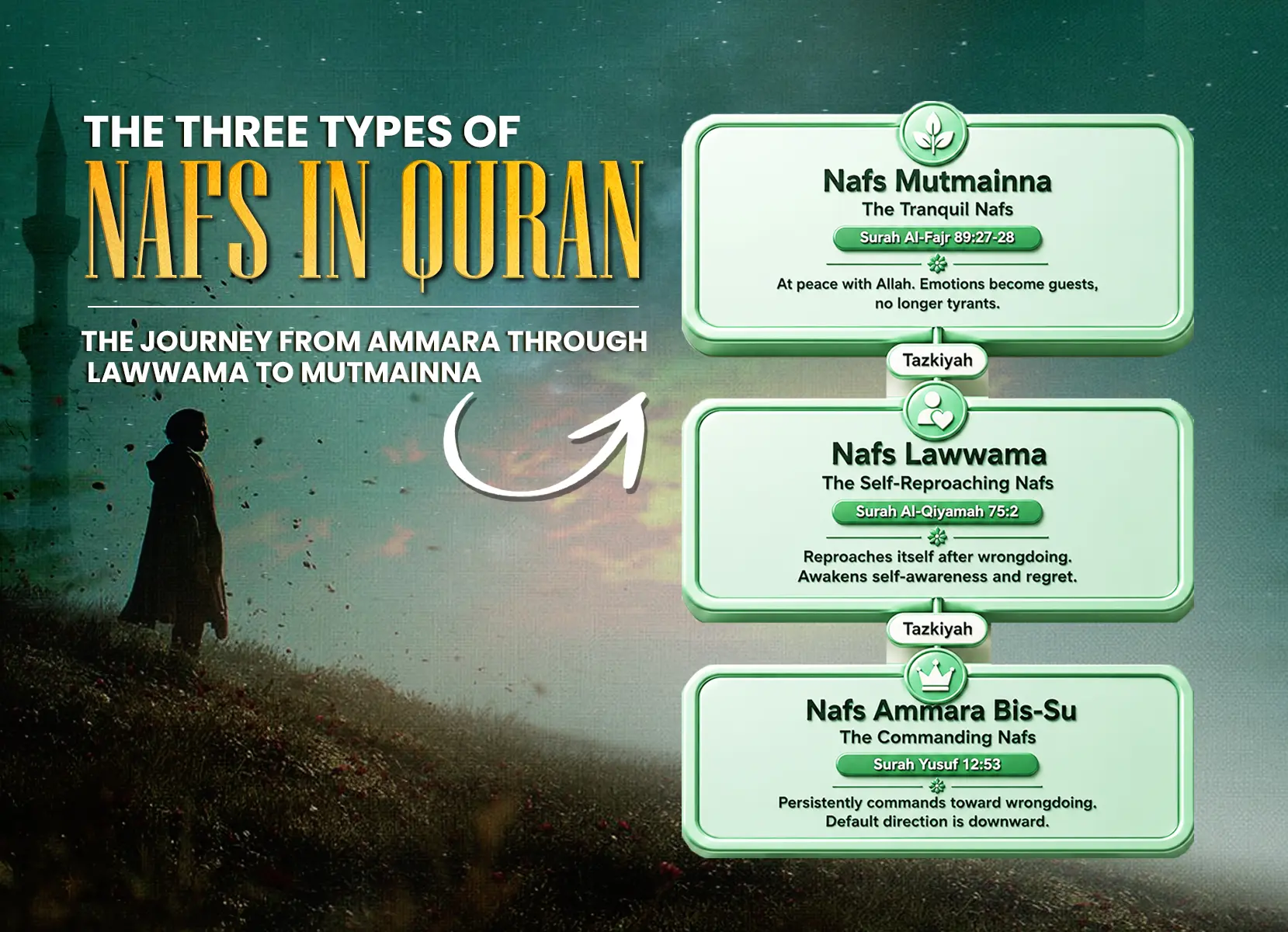
Understanding this movement is understanding the entire spiritual journey of a Muslim.
Type One: Nafs Ammara Bis-Su (النفس الأمارة بالسوء) — The Commanding Nafs
The first state is the state most people are stuck in without realising it.
Allah ﷻ describes it in the Quran through the words of Yusuf عليه السلام:
وَمَا أُبَرِّئُ نَفْسِي ۚ إِنَّ النَّفْسَ لَأَمَّارَةٌ بِالسُّوءِ إِلَّا مَا رَحِمَ رَبِّي
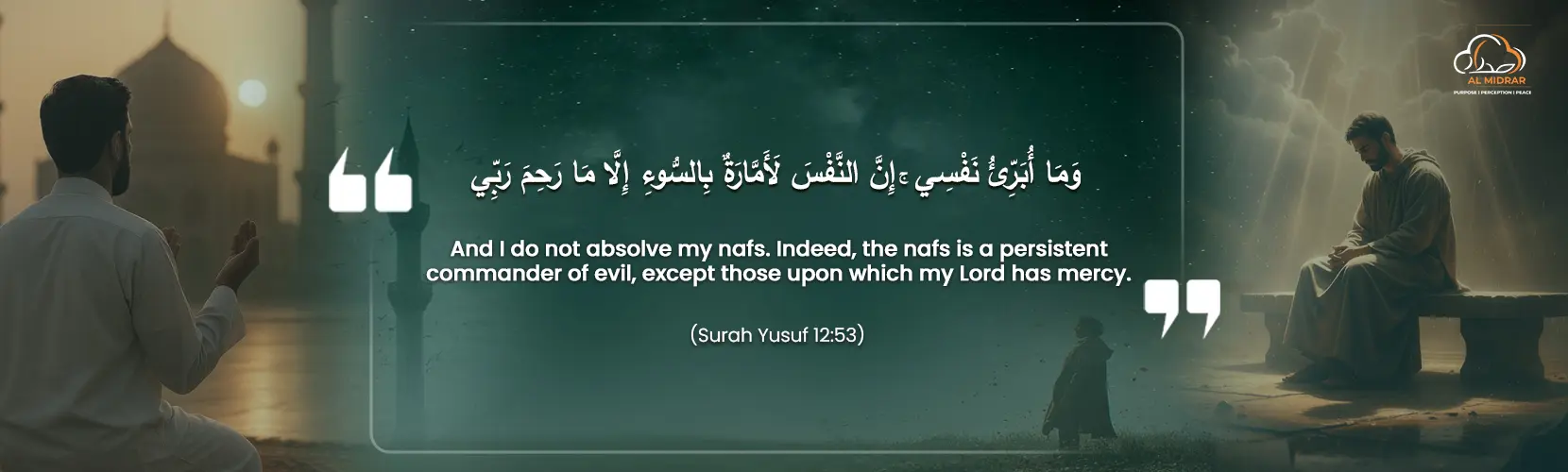
Look carefully at what Yusuf عليه السلام is saying. This is not just any human being making this admission. This is a Prophet of Allah ﷻ. A man who had just been offered the highest position in Egypt after years of imprisonment. A man of complete moral clarity. And yet, in his own words, he refuses to absolve his nafs. Because he knows that the nafs, left to itself, commands toward evil.
Imam Al-Tabari رحمه الله, in his classical tafseer, explains that the meaning of ammara بالسوء is a nafs that continuously and persistently pushes the human being toward wrongdoing. Not occasionally. Continuously. Its default direction is downward. If you leave it alone and give it what it wants, it will destroy you.
This is the state most human beings are in right now.
They are Muslim, they pray sometimes, they believe in Allah ﷻ, but their inner reality is being driven by a nafs that commands toward comfort, toward pleasure, toward escaping any form of discomfort, toward feeding the ego, toward avoiding the hard work of transformation.
How the Nafs Ammara operates:
- It tells you to sleep instead of praying fajr, and it makes the argument sound reasonable
- It tells you that one small sin will not matter, that Allah ﷻ is merciful, and that you can repent later
- It tells you that your anger at that person is justified, that they deserved what you said
- It tells you that the phone in your hand is fine, that this scroll is harmless, that the two hours you just lost were relaxation
- It tells you that you cannot pray tonight because you are tired, that Allah ﷻ understands, that tomorrow will be better
Every one of these voices is the nafs ammara making a case that sounds reasonable but is actually taking you further from Allah ﷻ with each accepted argument.
The dangerous thing about this state is that most people do not know they are in it. They think their thoughts are their own. They think their desires are legitimate. They cannot see that they are being commanded, moment by moment, by an inner force that wants their destruction.
Type Two: Nafs Lawwama (النفس اللوامة) : The Self-Reproaching Nafs
The second state is when the nafs begins to wake up.
Allah ﷻ swears by this state in the Quran:
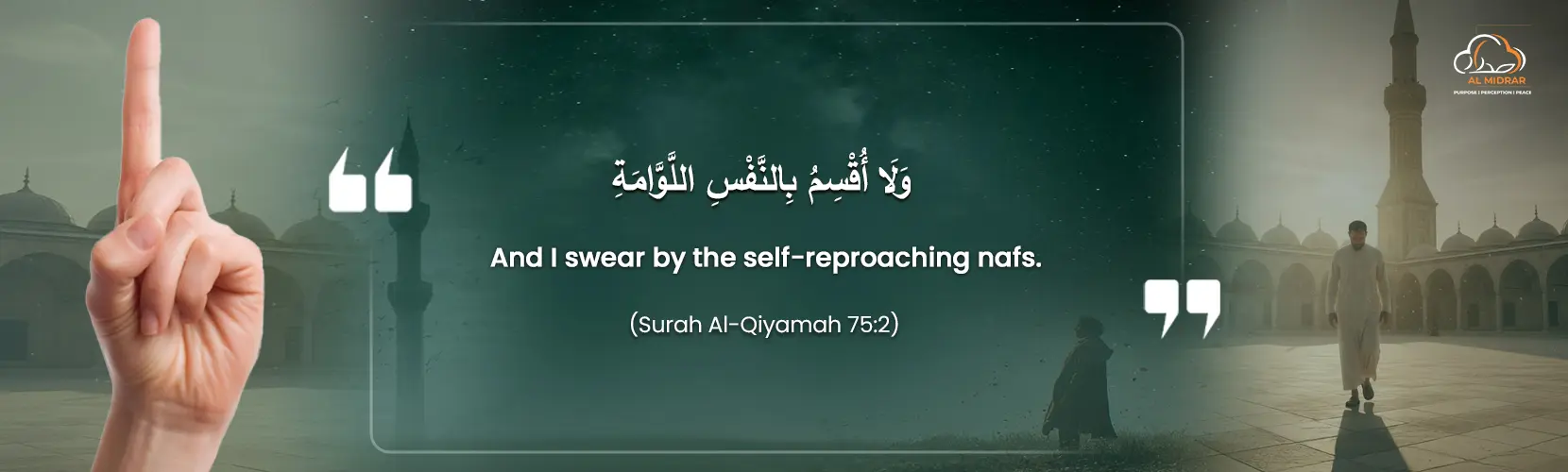
Beautiful people, notice something here. Allah ﷻ swears an oath by this state. When Allah ﷻ swears by something, it is because that thing carries enormous weight and significance. The nafs lawwama (النفس اللوامة)is worth swearing by.
What is the nafs lawwama?
It is the nafs that has begun to reproach itself. It has developed the capacity to notice its own wrongdoing and to feel genuine regret over it. It sins, but it does not sin comfortably. It slips, but it turns back. It fails, but it feels the failure.
Hasan al-Basri رحمه الله was asked about this state and he said something extraordinary. He said:
This is one of the most useful diagnostic tools I can give you. If you are constantly reproaching yourself, questioning your intentions, feeling regret over your slips, then Alhamdulillah, your nafs is at the Lawwama stage. This is a mercy from Allah ﷻ. This is a sign that His hand is guiding you upward.
If you are sinning without any reproach, if you find yourself justifying everything, if the concept of self-questioning does not enter your daily experience, then your nafs is still at the Ammara stage, and you have serious work to do.
But do not misunderstand this state. The nafs lawwama is not comfortable. Being at this stage often feels harder than being at the Ammara stage, because now you are aware of every wrongdoing. Now every mistake carries a wound. Now the disease is visible, and the pain is real.
This is a good thing. Feel the pain. Do not run from it. The pain of the nafs lawwama is the surgical incision that Allah ﷻ is making in your soul so that healing can begin.
Type Three: Nafs Mutmainna (النفس المطمئنة) : The Tranquil Nafs
The third state is the destination.
Allah ﷻ describes this state at the end of Surah Al-Fajr:
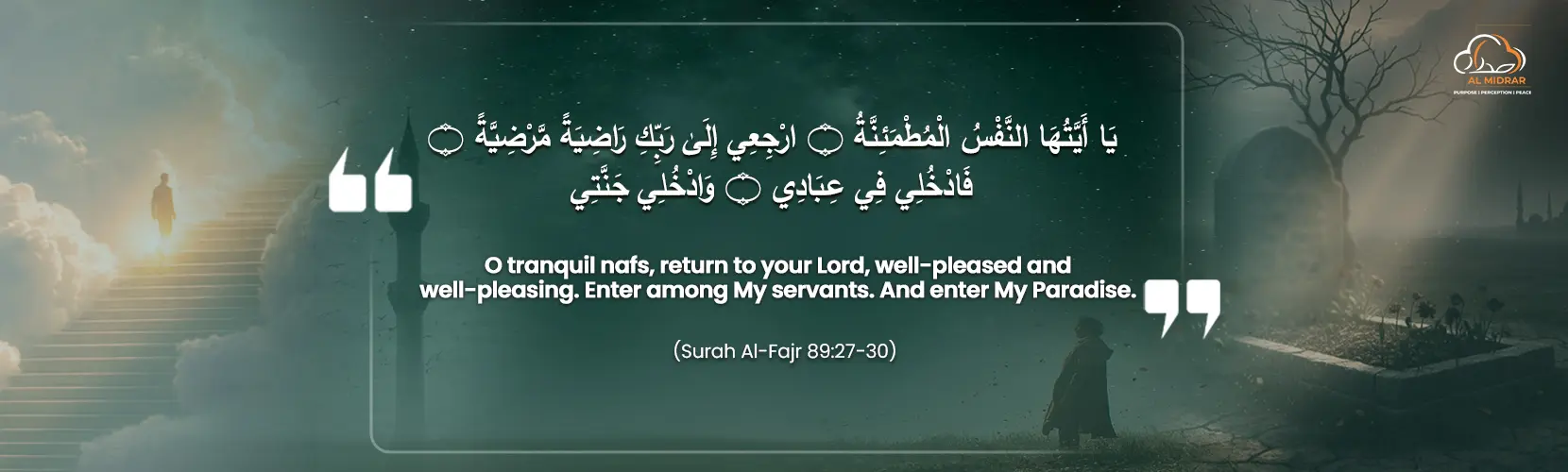
Beautiful people, sit with these verses for a moment. This is the destination Allah ﷻ has planned for you. This is what your soul is calling you toward. This is the nafs at peace. Not the peace of the world. Not the peace of comfort or wealth or ease. The peace of a soul that has finally stopped fighting Allah ﷻ and has returned to Him.
Characteristics of the Nafs Mutmainna:
The person at this stage no longer struggles with the same desires that used to torment them. Not because the desires have disappeared, but because their relationship to those desires has fundamentally changed. What used to shake them no longer shakes them. What used to seduce them no longer seduces them. Their consistency in worship is not a struggle. Their trust in Allah ﷻ is not a effort. Their contentment is not performed. It is real.
This is not a spiritual escape. This person still lives in the world. They still work, still marry, still raise children, still face difficulties. But underneath all of that, there is a settled centre. Their nafs is no longer pulling them apart. Their nafs is now pulling them upward.
This is where every Muslim must aim. Not because it is easy to reach. It is not easy. But because it is the destination Allah ﷻ has planned for those who submit to His path of transformation.
The House of Nafs Ammara: Understanding Who Actually Lives Inside You
Now I want to share with you a framework I have developed over years of counselling people through their spiritual struggles. I call it the House of Nafs Ammara. Because until you can see the house, you cannot see who is running your life.
Imagine that inside every human being, there is a house. This is the house of the nafs ammara. Right now, before you have done any work, this house is full of residents. Some of them are permanent. Some of them are guests. Some of them are prisoners locked in the dungeon. Each one has a role in what is happening inside you.
Let me walk you through who is in this house.
Resident One: The Nafs Itself
The nafs is the owner of this house. It runs the place. It sets the schedule. It decides who gets a voice and who gets locked away. It is not neutral. It has an agenda. Its agenda is comfort, pleasure, avoidance of pain, and the feeding of the ego.
When you sit alone at night and cannot understand why you are feeling what you are feeling, why you want what you want, why you do what you do, you are hearing the voice of this owner. It is not your voice. It is the voice of a resident who has been given too much power for too long.
Resident Two: Shaitan
Shaitan is not inside the house the way the nafs is inside the house. Shaitan operates from outside. But he whispers into the house through a specific channel, and the nafs opens the door to him more often than you realise.
Allah ﷻ tells us in the Quran, in the words of Iblees himself on the Day of Judgement:
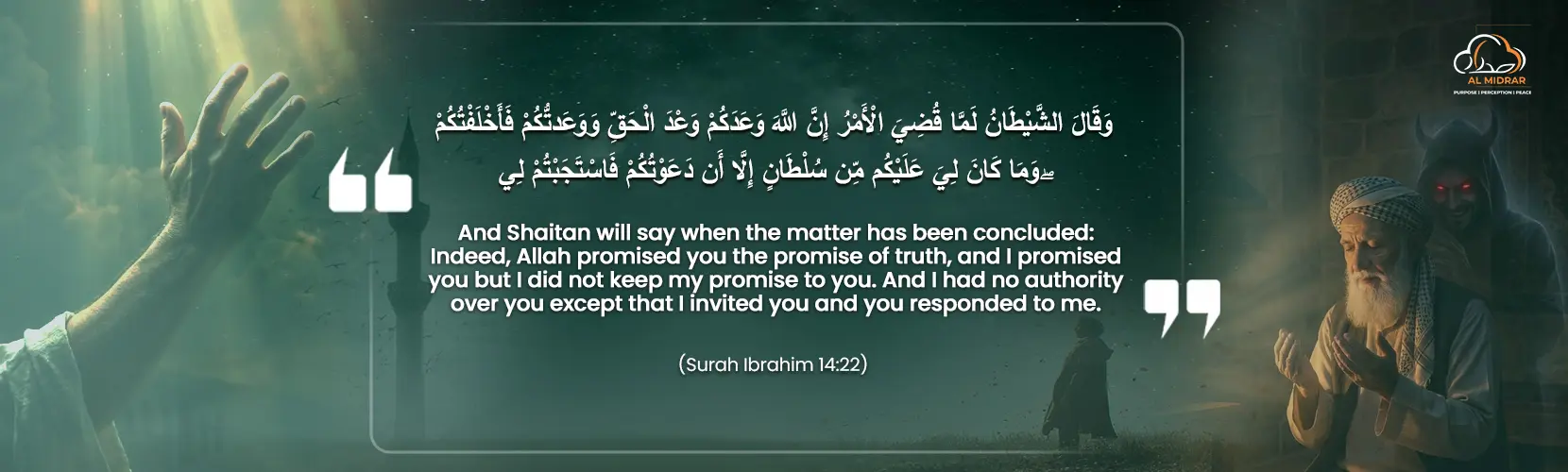
Look at this. On the Day of Judgement, Shaitan himself confesses that he had no authority over people. He only invited. They responded. This is a critical teaching. Shaitan cannot force anything on you. But the nafs ammara opens the door for him and responds to his invitations. The nafs is the traitor inside the house that keeps welcoming the enemy.
Resident Three: Bad Habits
Bad habits are permanent residents of the House of Nafs Ammara. They live in every room. They know the layout. They know exactly when to appear.
Modern research at Duke University found that approximately 40 percent of the actions people take on any given day are not decisions. They are habits. They are automatic patterns that fire without conscious choice. Charles Duhigg, in his research on the habit loop, described how habits form through a cue-routine-reward cycle. A trigger appears, an automatic behaviour follows, and a reward reinforces the pattern.
Beautiful people, this science is describing what Islam has been teaching for fourteen hundred years. The nafs ammara has established behavioural patterns inside you. When the cue appears, the routine fires automatically. You do not choose the response. The house responds through the resident who lives in that room.
This is why fighting the nafs is not just about willpower in the moment. It is about restructuring the residents. Because as long as the same residents live in the same rooms, they will keep answering the door when the cue comes.
Resident Four: Doubt and Hopelessness
Doubt and hopelessness are two residents who often work together. They are the ones who tell you that change is impossible. That you have tried before and failed. That Allah ﷻ will not accept you now. That you are too far gone. That your case is different from everyone else's.
Every one of these voices is a resident of the House of Nafs Ammara. They are not you. They are trying to convince you that they are you, but they are guests you never invited who have overstayed.
Resident Five: Emotions in the Guest Room
Emotions are a special kind of resident. They are not permanent, and they should not be permanent. They are guests. They come, they visit, and they leave. The problem is not that they exist. The problem is when they are given permanent rooms in the house and allowed to run things.
Look at the example of Pharaoh in the story of Musa عليه السلام. Pharaoh saw the miracles. He knew the truth. But his emotion of arrogance was given a permanent throne in his house, and that emotion ran his entire kingdom. He could not submit even when he wanted to, because arrogance had become the ruling resident.
Now look at Musa عليه السلام. He had emotions too. Anger, grief, fear. But he did not give them permanent rooms. He let them come and let them go. He let each emotion pass through the guest room without allowing it to take up residence.
This is one of the most important teachings I can give you. Your emotions are not you. Your emotions are guests. Feel them. Let them enter. Then let them leave. Do not give them permanent rooms in the House of Nafs Ammara.
The Two Imprisoned Residents: Fitrah and Yaqeen
In the dungeon of the House of Nafs Ammara, two extraordinary residents are locked away.
One: The Fitrah. The Fitrah is the pure original nature Allah ﷻ created you with. Every human being is born on the Fitrah. It is the compass that points toward truth. But in the House of Nafs Ammara, the Fitrah is imprisoned. The nafs does not want you to hear its voice, because if you heard the Fitrah clearly, you would immediately reject much of what the nafs is doing.
Two: The Yaqeen (Certainty). The Yaqeen is the deep certain knowledge of Allah ﷻ, of His promise, of the Day of Judgement, of the truth of what the Prophet ﷺ taught. Every believer has some Yaqeen. But in the House of Nafs Ammara, the Yaqeen is also imprisoned. The nafs keeps it locked away because Yaqeen is the one thing that could immediately overthrow the entire regime.
Beautiful people, the entire spiritual struggle can be understood as the effort to release these two prisoners. When the Fitrah is freed, you begin to see clearly again. When the Yaqeen is freed, you begin to act on what you see.
The work of the next blog in this series will be exactly this: how you release these prisoners and take back your own house.
Hadith About Nafs: What the Prophet ﷺ Taught
The Prophet Muhammad ﷺ taught the Companions about the nafs as a living reality that every human being must understand. The following authentic hadith establish the foundational Prophetic teaching on the nature of the nafs.
Hadith About Nafs: What the Prophet ﷺ Taught
The Prophet Muhammad ﷺ taught the Companions about the nafs as a living reality every human being must understand.
On subordinating the pull of the nafs:
Anas ibn Malik رضي الله عنه narrated that the Prophet ﷺ said:
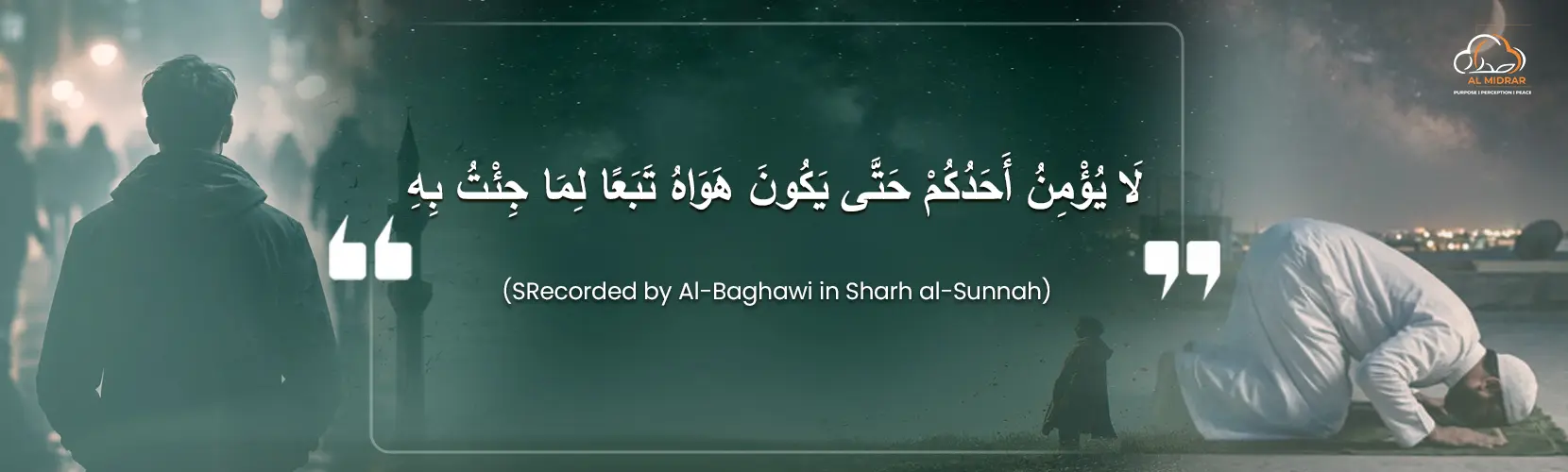
[Recorded by Al-Baghawi in Sharh al-Sunnah]
The word for desires here is hawa, the pull of the nafs. Iman is not complete until this pull is brought under the guidance of revelation. The nafs still exists, but it is no longer the ruler.
On the two forces pulling every human being:
The Prophet ﷺ described the inner reality of every believer:
“There are two graspings that pull at the son of Adam: a grasping from the angel that urges toward good, and a grasping from the enemy that urges toward evil.”Sunan at-Tirmidhi 2988
Beautiful people, this is one of the clearest maps of the inner life ever given. Two pulls, every moment. One from the Fitrah and the Yaqeen. One from the nafs ammara. Your work is to be pulled by the first.
You Do Not Have to Fight Your Nafs Alone
Beautiful people, we understand what you carry. The patterns you cannot break. The prayers you cannot keep consistent. The old temptations that return when you thought you had moved past them. Every one of us has sat with people walking through exactly this. At Al Midrar, our counsellors are trained in the classical Islamic framework of the nafs alongside the practical work of change, ready to sit with you through your specific struggle.
Book a confidential counselling session here.
May Allah ﷻ grant our nufus their taqwa. Ameen.
Frequently Asked Questions About Nafs
Q1: What is nafs in Islam?
Nafs in Islam refers to the inner dimension of the human being that carries desires, appetites, ego, and the capacity for both good and evil. It is distinct from the ruh (spirit) and the qalb (heart). The Quran describes the nafs in three primary states: Ammara أَمَّارَة (commanding toward evil), Lawwama لَوَّامَة (self-reproaching), and Mutmainna مُطْمَئِنَّة (tranquil). Understanding your nafs is essential to the entire spiritual journey in Islam.
Q2: What is the difference between nafs, ruh, and qalb?
The ruh is the divine spirit that Allah ﷻ blew into the human being at creation. It is what makes you alive in the highest sense. The qalb is the heart, the seat of iman and the moral centre of the human being. The nafs is the inner self that carries desires, ego, and the capacity for good and evil. All three exist inside every human being, but they are distinct dimensions with distinct functions.
Q3: What are the three types of nafs in Islam?
The three types of nafs mentioned in the Quran are: Nafs Ammara (the commanding nafs that pushes toward wrongdoing, Surah Yusuf 12:53), Nafs Lawwama (the self-reproaching nafs that feels regret over its wrongdoings, Surah Al-Qiyamah 75:2), and Nafs Mutmainna (the tranquil nafs that has returned to a state of peace with Allah ﷻ, Surah Al-Fajr 89:27-28).
Q4: What is Nafs Ammara?
Nafs Ammara Bis-Su النَّفْسُ الْأَمَّارَةُ بِالسُّوءِ is the state of the nafs that persistently commands the human being toward wrongdoing. It is described in Surah Yusuf 12:53 in the words of Yusuf عليه السلام. This is the state most human beings are in without realising it. Its default direction is downward, and if left unchecked, it will destroy the person's spiritual life.
Q5: What does Nafs e Lawwama mean?
Nafs e Lawwama means the self-reproaching nafs. It is the state where the nafs has begun to notice its own wrongdoing and feel genuine regret over it. Allah ﷻ swears an oath by this state in Surah Al-Qiyamah 75:2. It is a mercy from Allah ﷻ, indicating that the person's spiritual journey is progressing upward from the lower state of Ammara.
Q6: What is Nafs e Mutmainna?
Nafs e Mutmainna is the tranquil nafs, the state of complete peace with Allah ﷻ. It is described in Surah Al-Fajr 89:27-28 where Allah ﷻ calls this nafs to return to Him well-pleased and well-pleasing. This is the destination of the spiritual journey, where the nafs has been purified and no longer struggles against Allah ﷻ.
Q7: Is nafs the same as soul?
No, nafs is not exactly the same as soul in the English sense. English translations sometimes render nafs as "soul," but this is imprecise. The Arabic tradition distinguishes between the ruh (which is closer to the concept of soul or spirit) and the nafs (which is the inner self carrying desires and ego). Confusing the two leads to significant misunderstanding of Islamic spiritual teaching.
Q8: What does the Quran say about the nafs?
The Quran mentions the nafs in many verses. Key references include Surah Ash-Shams 91:7-10 where Allah ﷻ describes how He created the nafs with both the capacity for wickedness and taqwa, Surah Yusuf 12:53 on Nafs Ammara, Surah Al-Qiyamah 75:2 on Nafs Lawwama, Surah Al-Fajr 89:27-30 on Nafs Mutmainna, and Surah Ash-Shams 91:9-10 on the success of the one who purifies the nafs and the failure of the one who corrupts it.
Q9: Can the nafs be destroyed?
No. Islam does not teach the destruction of the nafs. The Quran commands purification (tazkiyah), not destruction. The goal of the spiritual journey is to move the nafs from Ammara through Lawwama to Mutmainna, ultimately purifying it so that it returns to Allah ﷻ in a state that pleases Him. The nafs is a creation of Allah ﷻ and carries genuine potential for good when properly educated.
Hasnain Irshad
Hasnain Irshad is the editorial lead at Al Midrar Institute. A graduate of Jamia Abi Bakr, he oversees the site's blogs on Islamic history, the biographies of the Sahaba, and the Quranic sciences.
Every blog under his supervision is grounded in classical Sunni sources. No unauthenticated narrations. No fabricated attributions.